From Lake Baikal to New York: The Story Behind Marianovich Gems
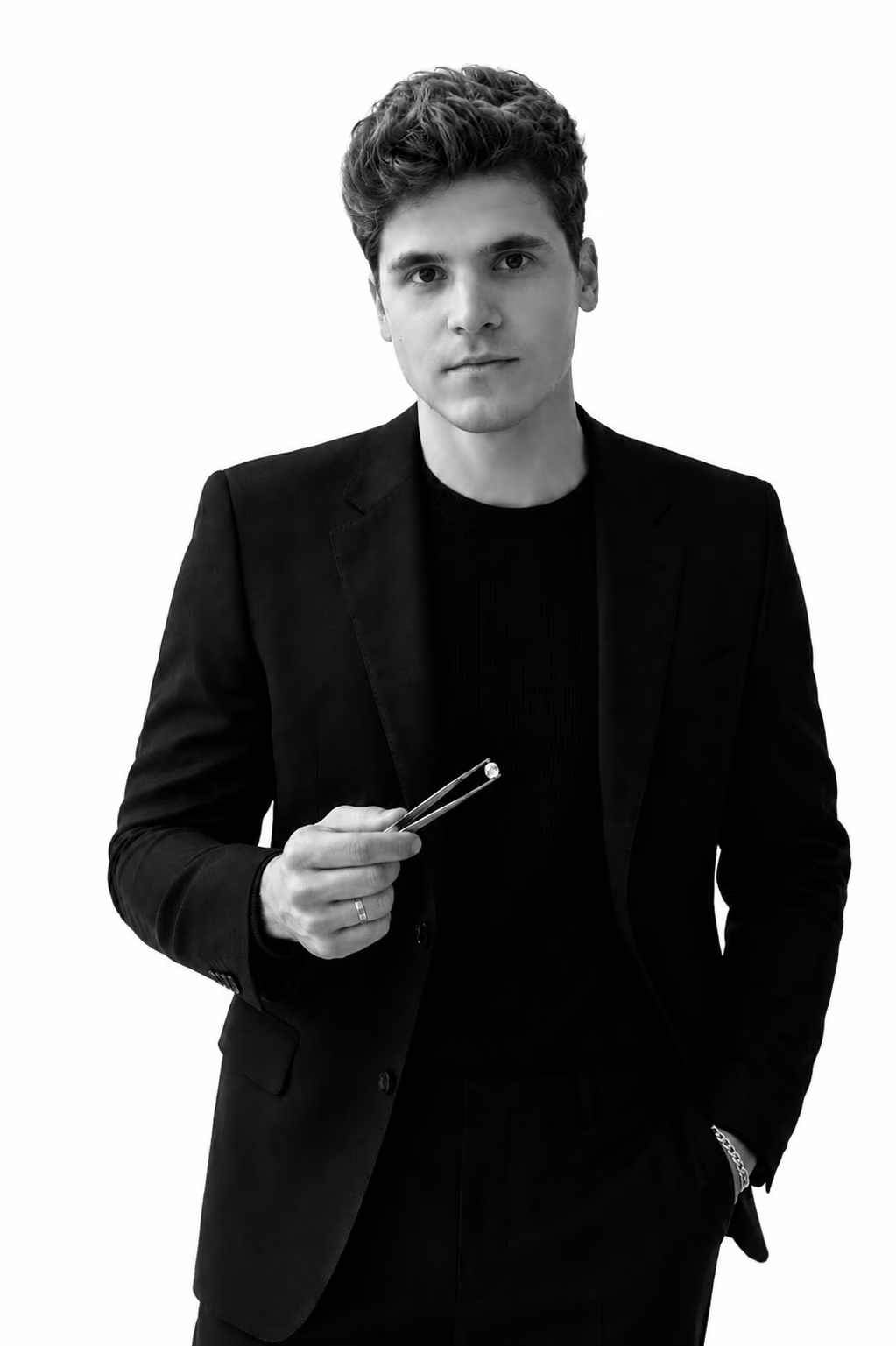
How a young man who found tourmalines at Lake Baikal and traded them for a Russian emerald built a gemstone business on direct relationships with deposit owners.
Who I Am
As a child, traveling to Lake Baikal, I found several tourmalines myself — with my own hands, among the tailings of the Malkhan deposit north of the lake. Later, at a mineralogical exhibition, someone offered to trade a Russian emerald crystal for them. I agreed, not because I understood the value of the deal — at that age, I wasn't thinking in terms of money or science at all. I simply felt that stone had to be mine...
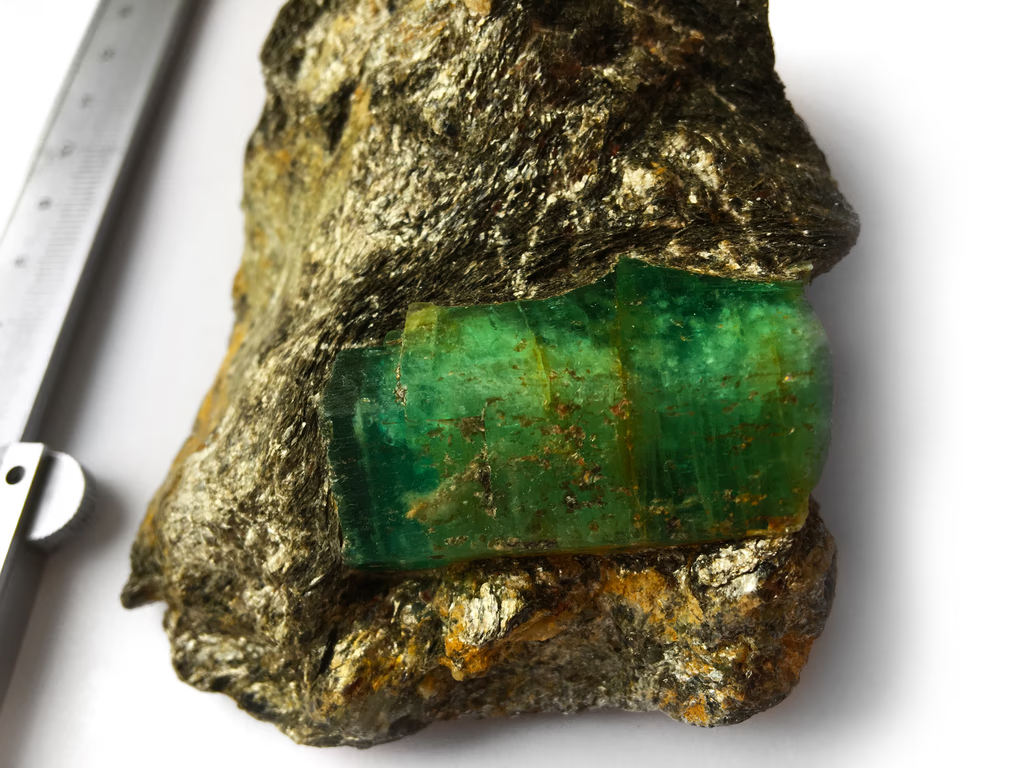 It was a Russian emerald from the Malysheva Mine in the Urals — the same deposit whose stones you see in the photograph above. Today I'd put it differently: business isn't always measured in money — sometimes it's simply a fair, mutually rewarding exchange between two people who understand what they're looking at. I haven't changed that principle in twenty years.
What Fersman Taught Me
As a teenager, I read Alexander Fersman's Entertaining Mineralogy — it became something like a bible to me. Fersman described the crystal lattice as the pinnacle of natural harmony: every atom in its precise place, a flawless geometric order rising out of the chaos of the amorphous world.
Inside a diamond, an emerald, any crystal, there's an architecture no human designed — and that is exactly what makes it more beautiful than anything made by hand. I haven't strayed from that philosophy since. To me, every stone is a frozen moment of absolute order, formed deep in the earth millions of years before anyone decided what it was worth.
Finding What Others Couldn't
I discovered early on that I had an unusual gift for finding what others couldn't. On expeditions with the MSU Geological School, which I joined while still in high school, our group often numbered around forty people. We traveled to the Slyudyanka deposit south of Baikal, home to lavrovite — a mineral found nowhere else on earth, and one so rare that a real find is an event even there.
The whole group searched all day. I was the one who found it: a beautiful, richly-colored druse of lavrovite crystals on matrix. At that same site, I was also the only one to find a crystal of blue spinel. It happened again and again, at every deposit we visited. I can't explain it rationally — I simply knew where to look.
Moscow: Quarries, Chemistry, and Field Seasons
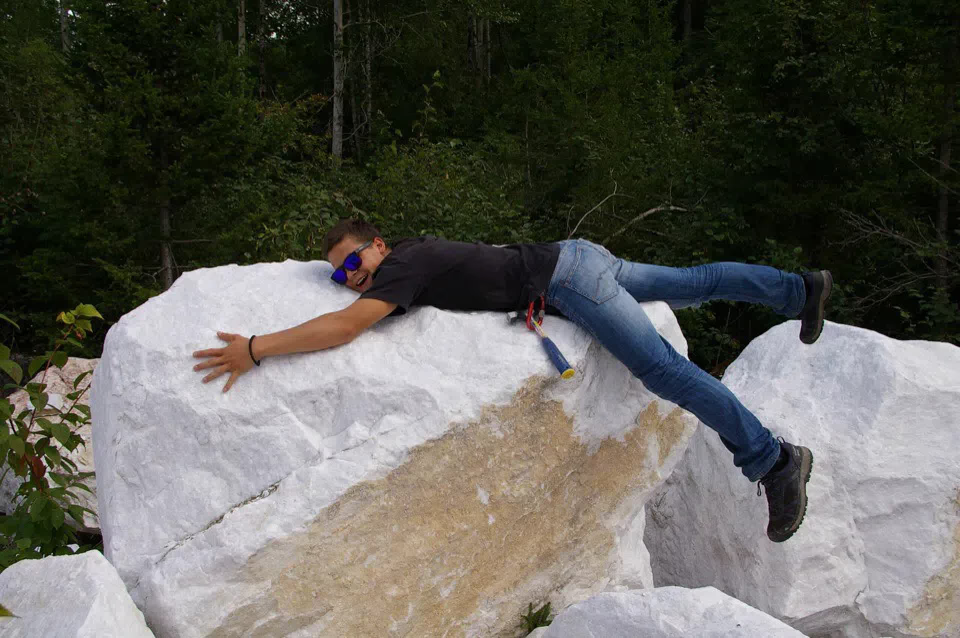
I was born and raised in Moscow, but the mountains and quarries always pulled harder than the city. From early childhood I climbed through quarries and mine tailings, collecting whatever the earth had left exposed. That habit never really stopped — it just grew more disciplined.
I attended a specialized chemistry school in Moscow, going deep into inorganic chemistry, while in parallel, during my senior years, I studied at the MSU Geological School, joining field expeditions across Russia. In high school I also taught chemistry and gave public lectures on minerals and gemstones at the Polytechnic Museum in Moscow — sharing with others what had already become, for me, closer to a calling than a hobby.
Around age fourteen I started doing business and taking part regularly in mineralogical exhibitions in Moscow. I went on to win two All-Russian geology olympiads in the mineralogy section, and wrote and defended two scientific papers on mineralogy.
New York, GIA, and Marianovich Gems
In 2019, I moved to New York. I completed my GIA coursework there and earned a bachelor's degree in business — building the vocabulary and the discipline to turn a lifelong obsession into a profession. I've participated in the Tucson Gem Show every year since 2020, and in 2024 I founded Marianovich Gems with my family - the same passion for stones, now passed down and shared.
Straight From the Deposit
That same instinct that once led me to a lavrovite druse no one else could find has shaped how I built this business: through direct, long-standing relationships — not markets, not middlemen — with the people who own the deposits themselves. Close ties with the owners of horsetail demantoid, color-change alexandrite, Russian emerald, and tourmaline deposits let us bring these stones to you nearly first-hand.
In 2026, that same approach let us debut something that had never been offered on the Western market before: unheated sapphires from the Sutara deposit in the Russian Far East. The deposit is now closed — nothing more will ever be mined there.
We were able to acquire everything that had already been extracted, and we're still cutting through that reserve today, with new finished pieces still to come. A handful of individual specimens remain in private hands inside Russia, but no one else holds anything close to our volume. In every practical sense, we are the last hands these stones will ever pass through.
What Actually Matters
I've never chased fame, money, or scientific recognition. What matters most to me is reputation, and the kind of relationships that last — with people who see, in a stone, a little more than a chemical formula or a price tag.
Key takeaways
- Marianovich Gems was founded in New York in 2024 by Sergey Marianovich, who has traded stones since age fourteen.
- Trained in inorganic chemistry in Moscow and at the MSU Geological School; two All-Russian geology olympiad wins and two defended mineralogy papers; GIA coursework and a business degree completed in New York.
- Stones are sourced through direct, long-standing relationships with the owners of the deposits themselves — horsetail demantoid, color-change alexandrite, Russian emerald and tourmaline — rather than through markets or middlemen.
- In 2026 the company debuted unheated sapphires from the Sutara deposit in the Russian Far East, never before offered on the Western market.
- The Sutara deposit is now permanently closed; Marianovich Gems acquired the full extracted reserve and is still cutting finished pieces from it.