Demantoid: The Real Diamond
Demantoid garnet has more fire than diamond, no synthetic equivalent, and shrinking Russian supply — which is why it now rivals diamond at $5,000–$10,000 per carat.
The stone that was mistaken for emerald
In the mid-19th century, local prospectors panning the gold-bearing gravels of Russia's Ural Mountains, near the Bobrovka River, kept finding strange green pebbles. At first, no one knew what they were looking at — the color was close enough to emerald that some assumed they'd struck emerald, while others sold the stones under the name "Ural chrysolite," the old term for peridot. It took a Finnish mineralogist, Nils Gustav Nordenskiöld, to identify the material correctly: not emerald, not peridot, but a chromium-bearing variety of andradite garnet unlike anything seen before. He gave it a name that has stuck ever since — demantoid, from the old German demant, meaning diamond. The name wasn't an exaggeration. Demantoid's dispersion — the property responsible for a stone's "fire" — is actually higher than that of diamond itself. In the right cut, it doesn't just sparkle; it throws color in every direction.
By the end of the century, demantoid had become one of the signature stones of Russian jewelry, prized by Fabergé and the imperial court alike. Then, for most of the 20th century, it all but vanished from the market — production was sparse, sporadic, largely forgotten outside mineral collecting circles.
Only two sources worth talking about
At Marianovich Gems, demantoid is one of the stones we know best. We specialize in Russian material and carry a genuinely wide range — from stones as small as 1mm up to pieces reaching 7 carats. The reality of the demantoid market today is that there are, in practical terms, only two sources worth talking about: Russia and Iran. Madagascar and Namibia produce green garnet too, but not the same thing — the color falls short, and the material isn't true andradite in the way the classic Ural and Iranian stones are. Italy has demantoid as well, but not at gem quality. If you want the real, deep bottle-green color with real fire, it comes from Russia or Iran and nowhere else.
Where I think this is headed
Here's my honest read on where this stone is headed. The diamond market — at least for stones under 3 carats — is in a decline I don't think will reverse. Lab-grown synthetics keep getting cheaper, and the mass market is moving toward them fast. The investment-grade diamond segment will likely stay stable, but everything below that is going to keep losing ground. Demantoid is the opposite story. No commercially viable synthetic demantoid exists — which means every carat on the market today is exactly what it's always been: rare, natural, and increasingly hard to replace.
Proof you can see
That brings me to something I want to show you, not just tell you about: horsetail inclusions.
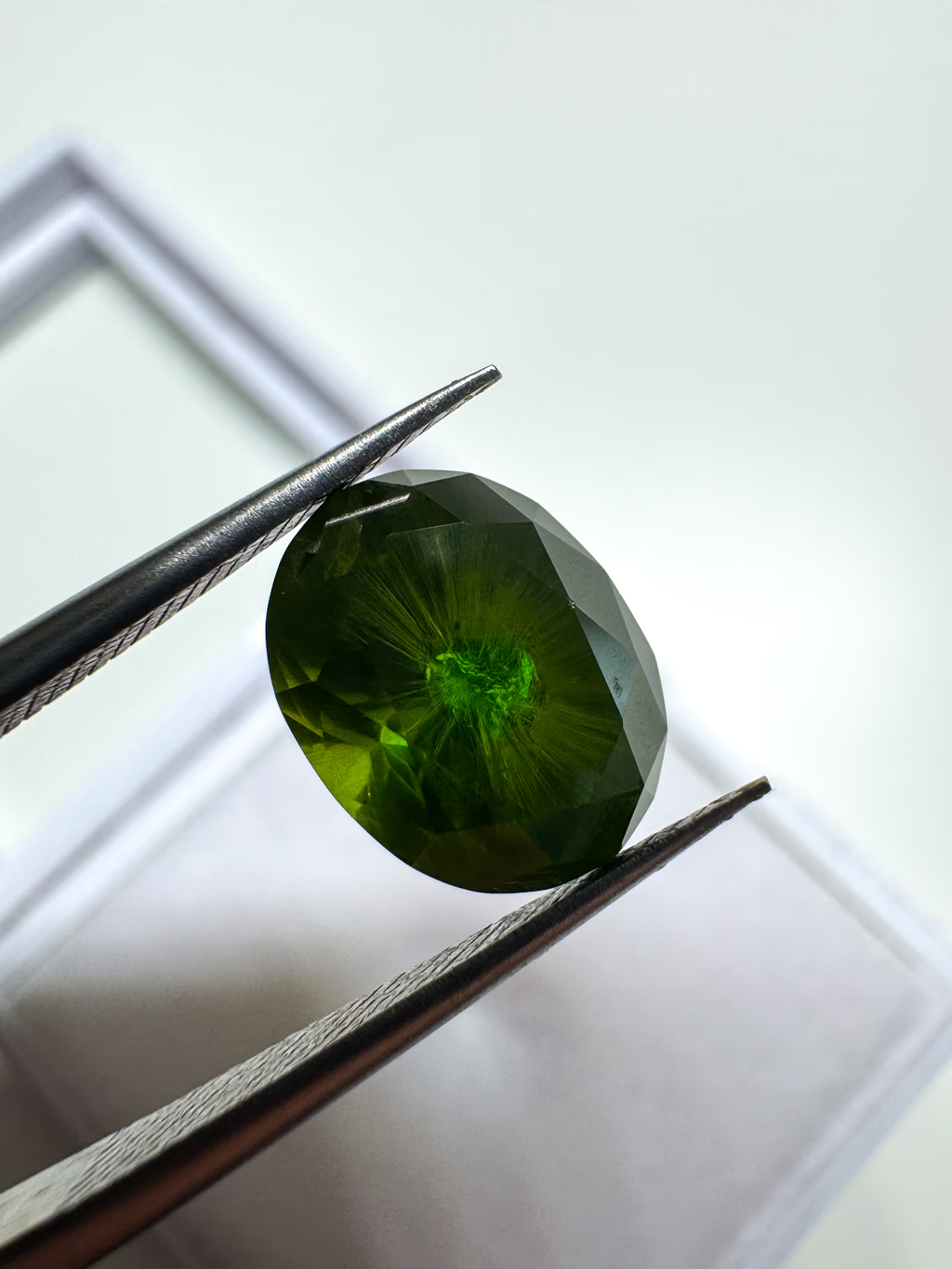
Look closely at the stone in the photograph below, and you'll see fine, radiating fibers spreading out from a point inside the gem — like a tiny golden or greenish starburst frozen in glass. These are horsetail inclusions: fibrous chrysotile crystals that grew alongside the garnet as it formed. They can't be faked, they can't be added, and they can't occur in a lab-grown stone. To me, that's what makes them valuable rather than a flaw. A diamond under 0.3 carats can be difficult even for a lab to certify with full confidence as natural. A horsetail inclusion in a demantoid removes that doubt entirely — it's proof of natural origin, visible to the eye, that anyone can trust without needing a certificate to explain it. In practice, a strong horsetail has become something close to a signature of Russian origin — horsetails do occur, rarely, in Iranian stones too, and when they do, that stone is worth even more than its Russian counterpart. But as a general rule, if you see a horsetail, you're most likely looking at a Russian demantoid.
Below are three stones from our collection that show exactly what I mean:
 An oval, 4.5 ct, held on tweezers, showing the classic radiating horsetail structure at its center
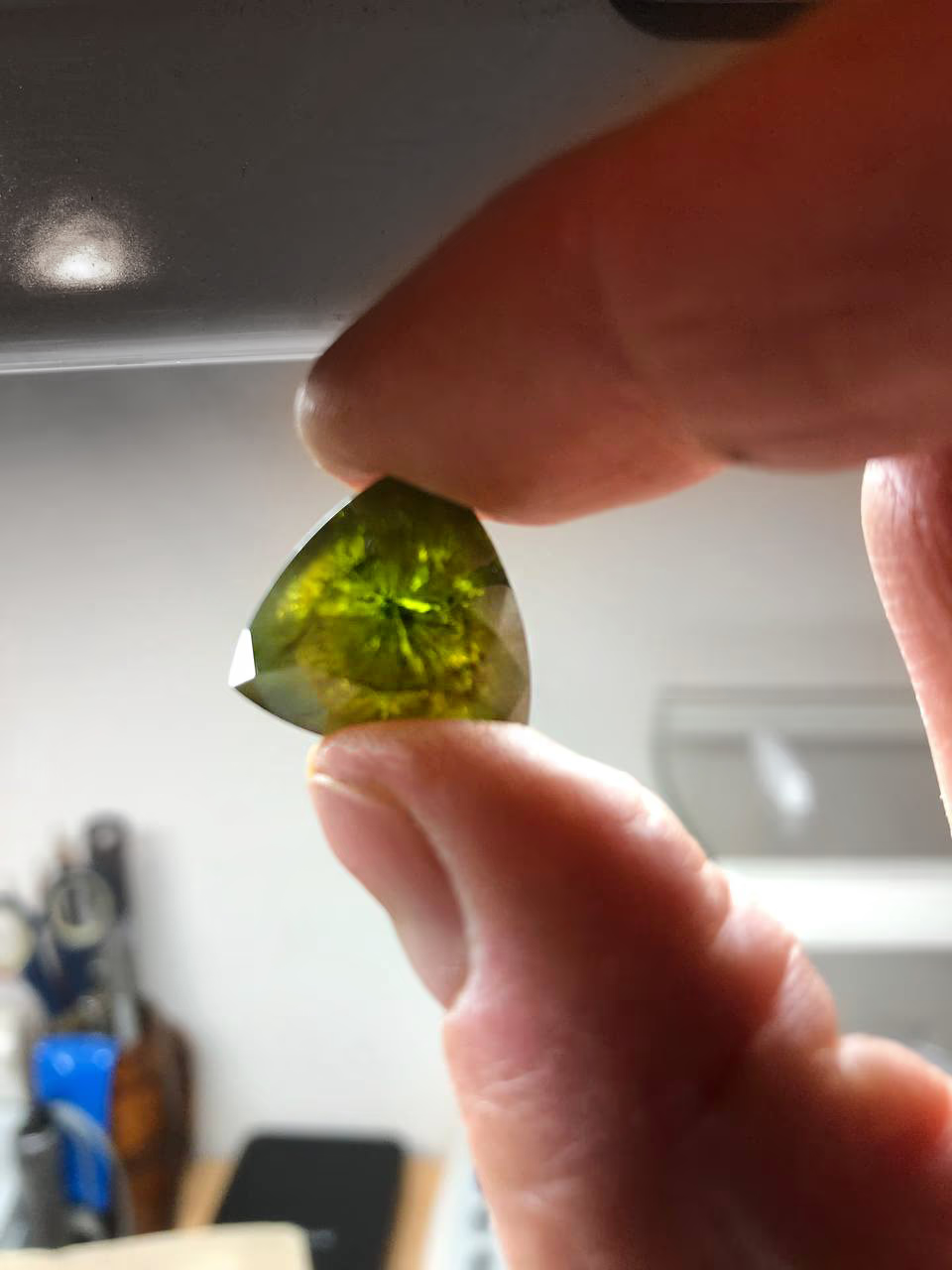 A trillion cut, nearly 30 carats — a stone with so many horsetail inclusions running through it that it reads almost like a piece of natural art. Most people have never seen a demantoid like this — not even in a museum
Demantoid
Poldnevskoye
4.14 ct
An oval, 4.14 ct, currently available — a working example of the color and fire we're talking about, not a museum piece behind glass
What the numbers actually say
Here's the honest picture, with numbers, not just impressions. Rapaport's own index shows exactly the split I've been describing. In 2025, small diamonds got crushed: the 0.30-carat RAPI index dropped 20.3% for the year, and 0.50-carat stones fell an even sharper 26%. Even 1-carat goods, long considered the industry's bread and butter, slid 9.9%. Meanwhile, diamonds of 3 carats and above barely moved — down just 0.3%, essentially flat. That's not a soft market correction. That's a market splitting in two: an investment-grade top that's holding, and a mass-market bottom that's in freefall, hollowed out by lab-grown synthetics that keep getting cheaper and more accepted. If you're buying a diamond under a carat today, you are buying into the losing half of that split.
Demantoid tells the opposite story, and the reason is supply, not sentiment. Good-quality demantoid today runs roughly $5,000 to $10,000 per carat — already closing in on diamond territory. Above 2 carats, prices have genuinely gone into orbit: I've seen a clean 2-carat stone on the market priced at $60,000. And the supply side is only getting tighter. Poldnevaya and Korkodino — the primary bedrock deposit — have produced fewer and fewer stones every year for the past three years, with no improvement in sight. What I'm hearing directly from the miners themselves is that the material appears to be running out: no new pockets are being found. On top of that, the current political situation is doing real damage to any prospect of expanded mining there. Put simply: production is shrinking, no synthetic exists to fill the gap, and demand keeps rising. That is exactly the setup that drives sustained price appreciation — and it's why I believe demantoid's climb has much further to go than diamond's ever will again.
Diamond and demantoid, side by side
To put the numbers side by side:
| Price per carat | |
|---|---|
| 1-carat natural diamond (RAPI, D-H, IF-VS2) | ~$4,150 as of January 1, 2026 |
| 3-carat natural diamond (RAPI, D-H, IF-VS2) | ~$18,200 as of January 1, 2026 |
| Good-quality demantoid (general market) | $5,000–$10,000 |
| Fine demantoid, 2 ct+ | up to $30,000 (a clean 2 ct stone recently listed at $60,000) |
Diamond figures: Rapaport Trade (RapNet Diamond Index), January 2026 press release.
A single-carat demantoid of strong color already sits in the same price band as a comparable 1-carat diamond — and above 2 carats, it starts pulling ahead. The diamond side of that table has been sliding for a year. The demantoid side hasn't stopped climbing since Poldnevaya and Korkodino started running dry.
A substitute, not an alternative
My honest opinion is that demantoid isn't just an alternative to diamond anymore — it's becoming a legitimate substitute for it. Price per carat has nearly caught up to top-quality diamond in the sizes that matter most to buyers. The difference is that diamond's price is increasingly artificial, propped up by a controlled market that's starting to crack. Demantoid's price is real, driven by genuine scarcity — and that's exactly why I expect it to keep climbing while diamond struggles to hold its ground.
Key takeaways
- Demantoid's dispersion — its "fire" — is higher than diamond's.
- Gem-quality demantoid comes from only two sources in practice: Russia and Iran.
- Horsetail inclusions are chrysotile fibers that prove natural origin, and usually point to Russian material.
- No commercially viable lab-grown demantoid exists, so every carat on the market is natural.
- Good-quality demantoid runs $5,000–$10,000 per carat; fine 2 ct+ stones reach $30,000.
- In 2025 the 0.30 ct diamond index fell 20.3% and 0.50 ct fell 26%, while 3 ct+ was essentially flat at −0.3%.
Frequently asked questions
What is demantoid?
A chromium-bearing green variety of andradite garnet, first correctly identified in Russia's Ural Mountains in the mid-19th century by the mineralogist Nils Gustav Nordenskiöld. Its dispersion — the optical property behind a stone's fire — is higher than diamond's.
Where does demantoid come from?
In practical terms, only Russia and Iran produce gem-quality demantoid. Madagascar and Namibia produce green garnet, but the color falls short and the material isn't true andradite in the same way. Italy has demantoid, but not at gem quality.
What is a horsetail inclusion?
Fibrous chrysotile crystals that grew alongside the garnet as it formed, radiating from a point inside the stone like a tiny starburst. They can't be faked, added, or produced in a lab, which makes them visible proof of natural origin — and usually a sign of Russian origin.
How much does demantoid cost per carat?
Good-quality demantoid runs roughly $5,000 to $10,000 per carat. Above 2 carats prices rise sharply, with fine stones reaching $30,000 and a clean 2-carat example recently listed at $60,000.
Is there a lab-grown or synthetic demantoid?
No commercially viable synthetic demantoid exists. Every carat on the market is natural — the key structural difference from the diamond market, where cheap lab-grown stones are driving prices down below 3 carats.